

MEMO: Trackpilot (TGAIN)
12 June 2026

A trackpilot follows a route accurately, but fundamentally changes the role of the master. Read what this means for alertness, legislation and safe use.
What happens when you navigate with a trackpilot?
Logically, you would say: the vessel follows a pre-set route. Or as is often put: "The vessel neatly follows the line on the chart." The various trackpilot systems used for this purpose are technically often very capable. Although there is sometimes debate about the exact position of the track on the chart, the technology does in most cases exactly what is asked of it.
In short: technically, the trackpilot does its job well.
What changes for you as master (helmsman, officer)?
The master remains responsible and is still seated in the wheelhouse, so little appears to have changed. Yet something important is shifting in the background. The constant, recurring steering corrections are suddenly no longer needed. The master now only checks whether the trackpilot is following its line and whether no other vessels are on that line. Much like placing a trainee at the helm and supervising their navigation.
In short: the role of the master genuinely changes when using a trackpilot.
Trust versus alertness
When it comes to supervision, the closely linked concepts² of trust and alertness play a major role. Does the following sound familiar?
-
The first time you used a trackpilot, you were probably extra alert. The system was unfamiliar and you had not yet built up confidence in it.
-
After a while, you found yourself comfortably leaning back in your seat. The trackpilot kept navigating smoothly, your trust grew, and your alertness decreased slightly. Because the system had been working without errors for some time, a natural tendency emerged to monitor it less actively. For example, by getting a coffee, doing something else, or thinking along with the trackpilot a little less. At some point, your trust and alertness reached a good balance.
-
The well-functioning trackpilot naturally caused your trust to keep growing. You noticed that your alertness was at risk of decreasing just as naturally.
-
Although this seemed like an almost inevitable connection, you manage to stay alert despite trusting the system.
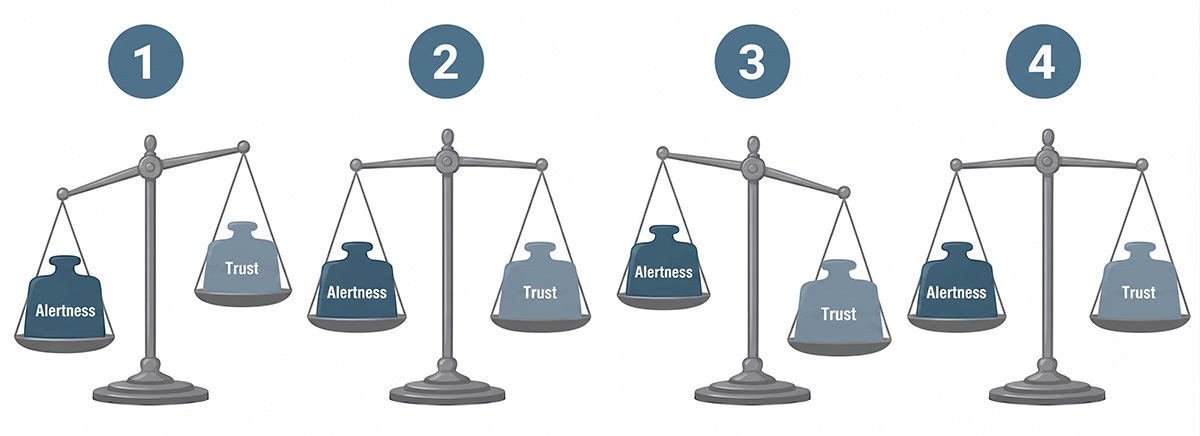
In short: when using a trackpilot, trust grows naturally while alertness quietly diminishes. Make a conscious choice to remain alert and actively think along with the trackpilot.
Out-Of-The-Loop performance (OOTL)
In addition to trust and alertness, another phenomenon plays a role: Out-Of-The-Loop performance, often abbreviated as OOTL. This essentially means that someone continues to supervise, but thinks along less and less actively with the operation of the vessel.
In aviation, extensive research has been conducted into pilots maintaining prolonged supervision over a well-functioning autopilot. That research¹˒³ shows that during prolonged and monotonous supervision, people:
- may experience fatigue or drowsiness more quickly (theta activity);
- become less alert and process what they see less effectively (alpha activity);
- think along less actively and understand what is happening around them less well (beta activity).
In short: the human brain is not well suited to prolonged passive supervision.
How do we keep the use of a trackpilot safe?
Legislation
It has probably not escaped your attention that more regulation is coming around the use of trackpilots. Initially, the authorities did not want to unnecessarily hinder the technical development of these systems. However, following a number of incidents, a decision was made to introduce additional rules. From 1 June 2026, temporary provisions were included in the RPR. From 1 January 2028, these will be incorporated into the ES-TRIN. The most important provisions are:
- The trackpilot may only be used as a navigation aid;
- The master must be qualified to navigate on the relevant section of the river;
- The master must remain present in the wheelhouse;
- The watch alarm interval must be set to 5 minutes or less;
- The trackpilot must be switched off in good time before entering a lock approach;
- Data from the trackpilot must be retained for a minimum of four days.
Awareness
The trackpilot is an important step forward in the automation of navigation. It is not, however, full automation; human intervention remains necessary. This is precisely what went wrong in recent and earlier trackpilot incidents. Awareness is therefore important. Using a trackpilot does not go well by itself; you must consciously continue to work on maintaining alertness and stand firm in that commitment.
Stay engaged
How quickly someone starts thinking along less actively varies by situation. In busy or complex situations, a master often naturally stays engaged. During long, monotonous watches, however, attention can decrease unnoticed and rapidly. The new rule requiring the watch alarm every five minutes is intended to regularly reactivate that engagement.
Consider different working hours
If you think about it realistically, no one can stay focused on a trackpilot for six hours at a stretch with arms folded. When navigating manually or with a traditional autopilot, a master stays alert because constant small corrections are required. When using a trackpilot, that alertness may be unnecessary in 95% of cases, but in the remaining 5%, things go wrong if no one intervenes.
Use alarms
Because the master navigating with a trackpilot may, for the reasons mentioned above, sometimes be less alert, alarms can help to redirect attention to potential hazards. Think of the risk of collision, crossing courses, lock and bridge passages, and so on. When switching from manual steering or autopilot to trackpilot, or vice versa, the master must also be alerted by an alarm. These alarms are necessary in case the master does not manage to consciously choose to maintain sufficient alertness.
Conclusion
A trackpilot works well technically. The navigating role shifts from an actively engaged role to a supervisory role in which the same level of alertness is required. When using a trackpilot, alertness remains necessary, but that alertness does not sustain itself during prolonged supervision. Everyone must work out that choice for themselves in a practically workable way. Should a hazard arise despite all well-intentioned efforts, the technology should, through alarms, bring the master back to an alert state.
References
- Bruno Berberian, Bertille Somon, Aïsha Sahaï, Jonas Gouraud (2017) The out-of-the-loop Brain: A neuroergonomic approach of the human automation interaction, Annual Reviews in Control, Volume 44, Pages 303-315, ISSN 1367-5788.
- Mike Salomone, Anne Guérin-Dugué, Bruno Berberian, Anton Andreev, Bertille Somon, et al.. (2025) Neural Correlates of Out-of-the-Loop: The Role of Trust and Vigilance in Supervising Automation. ICON 2025 - International Conference of Cognitive Neuroscience, Sep 2025, Porto, Portugal.
- Yiu, C.Y., Ng, K.K.H., Li, Q., Yuan, X. (2025). Identifying Human Out-of-the-Loop in Cruising Flights Using EEG Spectral Features with Deep Learning. In: Stephanidis, C., Antona, M., Ntoa, S., Salvendy, G. (eds) HCI International 2025 Posters. HCII 2025. Communications in Computer and Information Science, vol 2523. Springer, Cham.