

MEMO: ADN 2027 amendments
13 November 2026
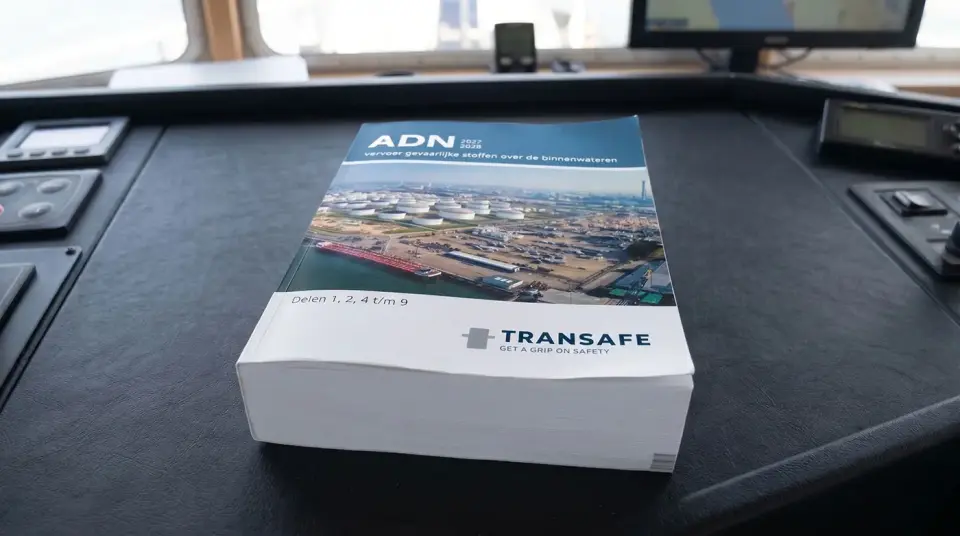
ADN 2027 enters into force on 1 January 2027. Until 1 July 2027, operations may still be carried out in accordance with ADN 2025; after that date the new provisions are mandatory. This memo gives a general overview of the amendments.
ADN 2027 enters into force on 1 January 2027. With this memo we inform you about the upcoming amendments, so that you can prepare for them. From 1 July 2027 the provisions of ADN 2027 are mandatory. Until that date, operations may also still be carried out in accordance with ADN 2025, if desired.
This memo gives you a general overview of the upcoming amendments, so that you can determine whether and to what extent these amendments are relevant to your own practice. The document on which this memo is based, containing the complete overview of the amendments in English and German, is attached as an annex.
Chapter 1.2 Definitions
A number of definitions have been added or amended. For example, the EEBD (self-contained escape device) is now also included as a permitted escape device. In addition, a definition of identical cargo has been introduced. This is part of the ongoing discussion on “blending on board”.
Escape device (suitable, self-contained): means a respiratory protection device which supplies the wearer with breathing air by means of pressurized air carried with him, designed to cover the wearer’s mouth, nose and eyes, which can be easily put on and which serves to escape from a danger area. For such devices, see for example standard ISO 23269-1:2008 or EN 1146:2005-12;
Identical cargo (two or more successive loadings): two or more batches of a dangerous substance accepted for carriage in a tank vessel from a single consignor, provided that:
(a)
These batches correspond to the same entry in Table C, “List of dangerous goods accepted for carriage in tank vessels in numerical order” under Chapter 3.2, with the same packing groups and the same hazards, and that the mixed loading of these batches does not entail any change in the classification and conditions of carriage;
(b)
There is no chemical reaction between the cargo batches; and
(c)
There is no reaction of the cargo with the construction materials of the tanks, gaskets, equipment and protective linings, and any weakening of these construction materials is excluded.
NOTE: For the purposes of this definition, the absence of cargo reactions means, for example:
(i)
No formation of new substances (e.g. release of flammable, asphyxiating, oxidizing or toxic gases or vapours; formation of flammable, corrosive, toxic, oxidizing or environmentally hazardous solids or liquids; formation of unstable substances);
(ii)
No decomposition or polymerization reaction;
(iii)
No combustion or evolution of considerable heat;
(iv)
No increase in pressure resulting from chemical reactions;
(v)
No catalytic reaction;
(vi)
No change in reaction capacity.
Chapter 1.3 Training
The training obligation for the persons involved in accordance with Chapter 1.3 has been clarified.
1.3.1
Amend the beginning of the first sentence to read: “Persons participating in the activities referred to in Chapter 1.4,”. In the second sentence, replace “Employees” by “They”.
1.3.2
After the existing text, add the following sentence: “The term "personnel", as used in 1.3.2.1, 1.3.2.2 and 1.3.2.3, is understood to include each person with an equivalent role or function.”.
1.3.3
At the end, add the following sentence: “These record keeping obligations extend to the persons mentioned in 1.3.1 except if the participants referred to in Chapter 1.4 are keeping these records.”.
Chapter 1.4 Safety obligations of the participants
A new obligation has been added for the filler and the unloader to ascertain that the loading, unloading and venting piping is drained and depressurized before connection or disconnection. The terminal must confirm this in text form to the master.
1.4.3.3
Add a new 1.4.3.3 (v) under the “Obligations concerning the filling of cargo tanks” to read as follows:
v)
He shall ascertain that the pipe connection to the loading and unloading piping and the pipe connection to the venting piping are drained and depressurized immediately prior to connection or disconnection and shall confirm this in text form to the master or the person appointed by him.
1.4.3.7.1
Add a new 1.4.3.7.1 (n) under “Additional obligations concerning the unloading of cargo tanks” to read as follows:
n)
He shall ascertain that the pipe connection to the loading and unloading piping and the pipe connection to the venting piping are drained and depressurized immediately prior to connection or disconnection and shall confirm this in text form to the master or the person appointed by him.
Chapter 1.6 Transitional measures
Several new transitional provisions have been included. The most notable transitional provision applies to UN No. 1202 with CMR properties (new third entry in Table C). In principle, this substance must be loaded with vapour return. If a terminal does not have vapour return, it may be loaded without vapour return until 31 December 2031 at the latest. In this case, the area within a radius of 2.00 m around the valves for depressurization must be marked as a danger area. For supply vessels, the existing transitional provision until 31 December 2038 continues to apply.
In addition, the obligation to carry the new instructions in writing on board has been postponed until 31 December 2027 inclusive. The mandatory separation between breathing air and working air has a transitional period until the renewal of the certificate of approval after 31 December 2029.
1.6.1.58
The instructions in writing in accordance with the requirements of ADN applicable up to 31 December 2026, but which do not however conform to the requirements of 5.4.3 applicable as from 1 January 2027, may continue to be used until 31 December 2027.
1.6.7.2.2.2
Add a new transitional provision to read as follows:

1.6.10
Transitional provision concerning the filling of UN No.1202, third entry in Table C of Chapter 3.2.
By derogation from 7.2.4.25.5, until 31 December 2031, it is not necessary to return ashore the gas/air mixtures released during filling, while filling UN No.1202, third entry, if the fillers facility is, by 31 December 2026, not equipped with a vapour return piping suitable for UN No.1202, third entry.
By derogation from 7.2.4.16.10, until 31 December 2031, the gas/air mixtures released during filling cargo tanks may be released using the devices for the safe depressurization of the cargo tanks referred to in 9.3.2.22.4 (a) or 9.3.3.22.4 (a). The area within a radius of 2.00 m around an outlet shall be marked as danger area.
Chapter 1.8 Checks and other support measures to ensure compliance with safety requirements
The competent authority is given wider powers to prohibit a consignment or to interrupt the transport operation if it observes defects or infringements.
1.8.1.4.3
If the competent authority observes that the requirements of ADN have not been met, they may prohibit a consignment or interrupt a transport operation until the defects observed are rectified, or they may prescribe other appropriate measures. Immobilization may take place on the spot or at another place selected by the authorities for safety reasons. These measures shall not cause a major disruption in shipping traffic.
Part 2 Classification
Several new UN numbers are included in Part 2. These mainly concern new UN numbers for various types of batteries. A prohibition of carriage is introduced for UN 9007 BULK CARGO, PREVIOUSLY FUMIGATED where it does not meet the requirements of the new special provision 804.
Chapter 3.2 Table A
In Table A, the classification codes, special provisions and the quantities permitted as limited quantities are amended for various UN numbers. New entries are added. UN 9007 concerns bulk cargoes that have previously been treated with a fumigant. More information on this subject and the explanation of special provision 804 can be found in our memo of 15 April 2026 on BULK CARGO, PREVIOUSLY FUMIGATED (identification number 9007). This memo is available via the button below.
MEMO: ID9007 Bulk cargo, previously fumigated

Chapter 3.2 Table C
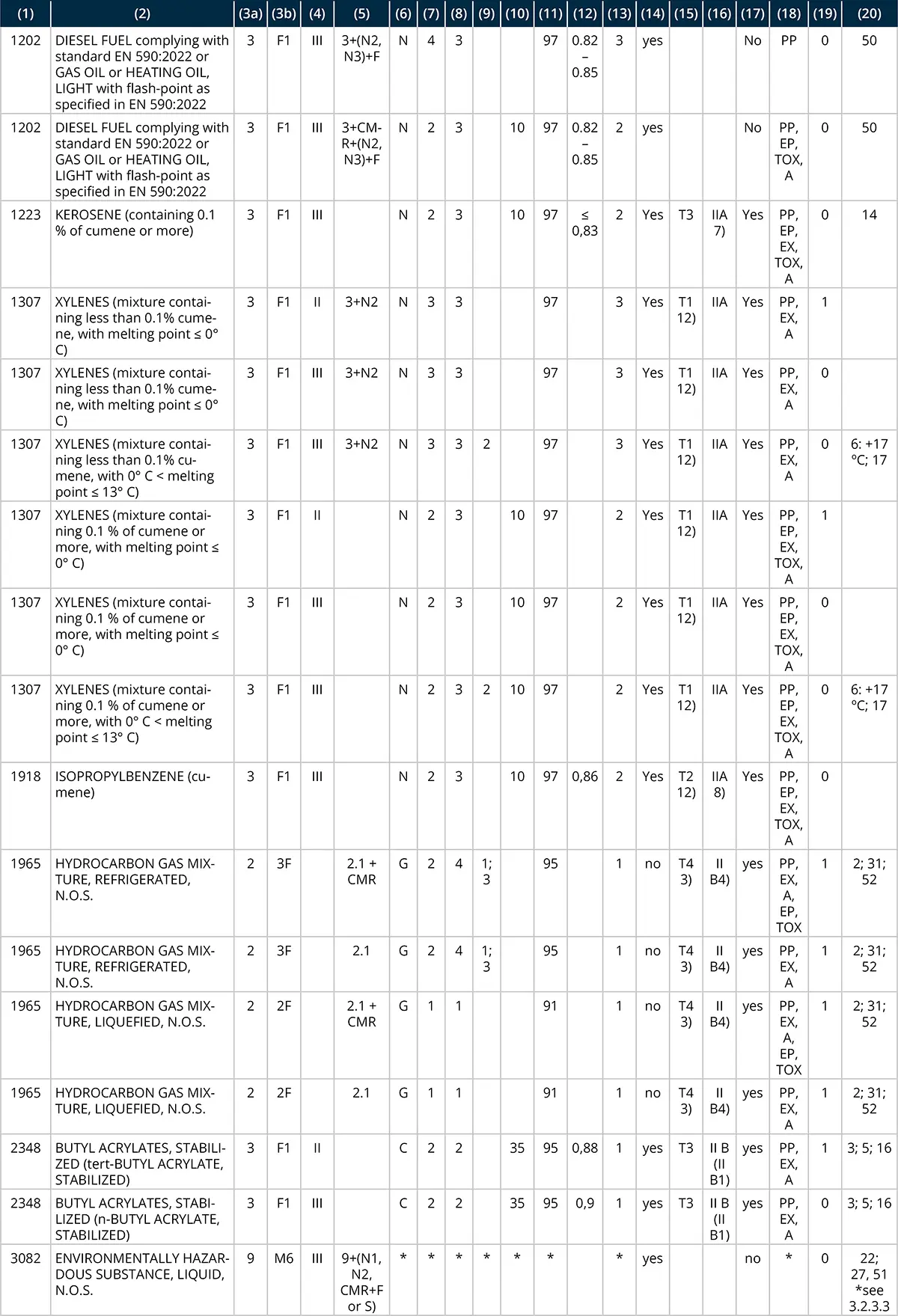
Several new remarks, with the related explanations, are included in column (20) of Table C. It is notable that remark 49 has not yet been assigned to any substance.
49.
If the conditions set out in the definition of identical cargo (two or more successive loadings) in 1.2.1 are met, several batches of this dangerous substance from a single consignor may be loaded successively.
50.
This entry shall also apply to diesel fuels in accordance with EN 16709:2024 or EN 16734:2023 or paraffinic diesel fuels in accordance with EN 15940:2023 or paraffinic heating oils with a flash-point according to EN 15940:2023.
52.
The proper shipping name shall be supplemented by the type of mixture (MIXTURE A, A01, A02, A0, A1, B1, B2, B, C, as per 2.2.2.3.).
Several UN numbers are amended or added. For UN No. 1202 a new entry is added with “CMR” in the hazards, which also affects the vessel type, the sampling device and the PPE. The description of the proper shipping name is also amended. Standard EN 590:2013 + A1:2017 has been replaced by EN 590:2022.
Chapter 5.4 Documentation
Preparations have been made to include carriage under remark 49 “Identical cargo” in the transport document. In addition, the content of the instructions in writing in accordance with 5.4.3.4 is amended. We advise you to update the instructions in writing as soon as ADN 2027 has been officially published. As mentioned above, a transitional provision applies until 31 December 2027 inclusive.
Chapter 7.1 Dry cargo vessels
In 7.1, the operational part for dry cargo vessels, a provision is included concerning entry into holds. Paragraph 7.1.3.1.5 now explicitly prohibits entering a hold with a filter mask, even if sufficient oxygen is present. It should be common knowledge that confined spaces may not be entered with filter masks (ambient air-dependent breathing apparatus). Filter masks may only be used on deck, in places with sufficient oxygen and low concentrations of product.
7.1.3.1.5
Amend the end of the first indent to read: “…and the percentage of oxygen is between 20 and 23.5 vol%. Entering with an ambient air-dependent breathing apparatus in accordance with 8.1.5.1 is prohibited; or”
Chapter 7.2 Tank vessels
In 7.2, the operational part for tank vessels, several provisions are amended, added and extended. For example, not every tank vessel of type C is any longer suitable as a substitute for a tank vessel of type N. This is only the case if all conditions listed in Table C are also met. This also applies to the other substitute tank vessel types described. In practice, this amendment has little effect, as tank vessels of type C generally meet the requirements.
The prohibition on the use of filter masks in confined spaces, such as cargo tanks, is also included for tank vessels. A provision is included that makes it possible to load identical cargoes on top of each other (although the required remark 49 has not yet been assigned to any substance). Provisions are included that will form a legal basis for requirements set out in the ADN checklist. These include connecting the overflow control device switch, the emergency stop for the unloading pump and agreements on emergency stop and alarm.
In 7.2.4.22.14, on the opening of openings of cargo tanks, opening for a measurement is now also permitted during unloading in the event of differing cargo quantities between shore and vessel. Previously, this was only stated as permitted during loading.
7.2.1.21.2
Substances, which according to column (6) of Table C of Chapter 3.2, have to be carried in a tank vessel of type N, open, may also:
a)
be carried in a tank vessel of type N, open, with flame arresters, type N, closed, or types C (except in the case of pressure cargo tanks), provided that all conditions of carriage prescribed for tank vessels of type N, open, as well as all other conditions of carriage required for these substances in Table C of Chapter 3.2 are met; or
b)
be carried in a tank vessel of type G or type C (with pressure cargo tanks), provided that the other requirements for equipment are at least equivalent.
7.2.1.21.3
Substances, which according to column (6) of Table C of Chapter 3.2, have to be carried in a tank vessel of type N, open, with flame arresters, may also:
a)
be carried in tank vessels of type N, closed, or type C (except in the case of pressure cargo tanks), provided that all conditions of carriage prescribed for tank vessels of type N, open, with flame arresters, as well as all other conditions of carriage required for these substances in Table C of Chapter 3.2 are met; or
b)
be carried in a tank vessel of type G or type C (with pressure cargo tanks), provided that the other requirements for equipment are at least equivalent.
7.2.1.21.4
Substances, which according to column (6) of Table C of Chapter 3.2, have to be carried in a tank vessel of type N, open, may also:
a)
be carried in tank vessels of type C (except in the case of pressure cargo tanks), provided that all conditions of carriage prescribed for tank vessels of type N, open, as well as all other conditions of carriage required for these substances in Table C of Chapter 3.2 are met; or
b)
be carried in a tank vessel of type G or type C (with pressure cargo tanks), provided that the other requirements for equipment are at least equivalent.
7.2.3.1.6
Amend the end of the first indent to read: “…and the percentage of oxygen is between 20 and 23.5 vol%. Entering with an ambient air-dependent breathing apparatus in accordance with 8.1.5.1 is prohibited; or”
7.2.4.8
The loading of two or more batches of a dangerous substance authorized for carriage in a tank vessel from a single consignor is permitted, taking into account 7.2.4.7.1, if the conditions set out in the definition of identical cargo (two or more successive loadings) in 1.2.1 are met and if remark 49 appears in column (20) of Table C of Chapter 3.2 for the dangerous substance to be carried.
7.2.4.13.4
The pipe connection to the loading and unloading piping and the pipe connection to the venting piping shall be drained and depressurized immediately prior to connection or disconnection.
7.2.4.19.2
Before the start of unloading operations any prescribed safety and control devices and any items of equipment shall, if possible, be checked and controlled for proper functioning.
7.2.4.19.3
Before the start of unloading operations the overflow control device switch, if applicable, shall be connected to the shore installation.
7.2.4.19.4
The pipe connection to the loading and unloading piping and the pipe connection to the venting piping shall be drained and depressurized immediately prior to connection or disconnection.
7.2.4.19.5
Before the start of unloading operations the device for switching off the on-board pump from the shore facility, if applicable, shall be connected to the shore installation.
7.2.4.22.14
Insert “or unloader” after “the filler”.
Chapter 8.1 General requirements applicable to vessels and equipment
Chapter 8.1 greatly extends the number of documents that may be kept on board in digital form instead of on paper. These include, among others, the inspection certificate of the insulation resistance (megger test), the certificates concerning the inspection of the fire-extinguishing hoses and of the other special equipment such as the gas detector. The inspection certificates of the loading and unloading hoses may now also be kept on board digitally. This already applied to the instructions in writing, the copy of the ADN and any special authorizations under which the transport operation is performed. Under certain conditions, the book in which all required measurement results are recorded may also be kept in digital form. For example, the book must be secured by a login, it must be clear who made the entries, and the content must be tamper-proof.
8.1.2.1
Add a new paragraph at the end to read as follows:
“The documents listed in subparagraphs (e), (f) and (k) may be kept on board electronically in PDF format according to standard ISO 32000-1, accompanied by an advanced electronic signature according to Regulation (EU) 910/2014, or at least equivalent.
The book according to paragraph (g) may be kept on board electronically if:
-
- The access to the book is protected by means of a log in;
- It is possible to identify who added entries in the book; and
- The entries in the book shall be tamperproof.”
8.1.2.2
“The documents listed in subparagraphs (c), (d), (e), (f), (g) and (h) may be kept on board electronically in PDF format according to standard ISO 32000-1, accompanied by an advanced electronic signature according to Regulation (EU) 910/2014, or at least equivalent.”
8.1.2.3
Add a new paragraph at the end to read as follows:
“The documents listed in subparagraphs (e), (f), (h), (j), (o), (p), (r), (s), (t), (u), (v), (w) and (x) may be kept on board electronically in PDF format according to standard ISO 32000-1, accompanied by an advanced electronic signature according to Regulation (EU) 910/2014, or at least equivalent."
Chapter 8.2 Requirements concerning training
ADN 2027 provides the option of partly completing training by means of e-learning. Offering lessons remotely through online meetings or providing the ADN course material in writing is also included. E-learning will only be permitted for the ADN refresher course. This is not the case for the basic training course and the specialization courses on chemicals and gases. Not all course days can be replaced by e-learning. The practical day with fire-fighting and gas measurement will still have to take place in person.
8.2.
After the title, add a note to read as follows:
NOTE: For the purposes of this Chapter, the following definitions shall apply:
"e-learning: asynchronous teaching conducted with information and communication technology (ICT) tools where trainees and trainers are separated in both space and time.”
“Distance learning: asynchronous teaching conducted without information and communication technology (ICT) tools where trainees and trainers are separated in both space and time.”
“Remote training: synchronous teaching conducted with information and communication technology (ICT) tools where trainees and trainers communicate with each other in real time while being physically separated.”
8.2.2.3
Add a second paragraph to read as follows:
“An initial training course may be delivered in person or through remote training, distance learning or a combination of these options. A refresher training course may be delivered in person or through remote training, e-learning or a combination of these options. Practical exercises must be carried out in the form of in-person training.”
8.2.2.4
Replace “Each day of training may comprise not more than eight lessons.” by “Lessons may be divided into shorter sections. Each day of training may comprise not more than eight lessons.”
8.2.2.5
Replace “Each day of training may comprise not more than eight lessons.” by “Lessons may be divided into shorter sections. Each day of courses may comprise not more than eight lessons. If the theoretical training is by e-learning, the lessons must be equivalent. Training by e-learning shall be completed within a period of three months.”
Chapter 8.6 Documents
One of the most noticeable amendments in daily practice is probably the revision of the ADN checklist. The order of the questions on the checklist more closely follows the order of the operations on board in practice. In addition, the explanations to the checklist have been greatly extended, making it easier to use and reducing errors when it is completed. For example, it now explains more clearly what is meant by the “estimated residual quantity”. The new checklist may be used as soon as ADN 2027 has entered into force. The ADN 2025 model may still be used until 30 June 2027 inclusive.
An example of the new model can be viewed via the button below.
Chapter 9.3 Rules for construction of tank vessels
In terms of construction, ADN 2027 contains few amendments. A notable change is the permitted position on deck of the piping for loading and unloading on vessels with a breadth of 11.40 m or more. In principle, the piping must be located not less than a quarter of the vessel’s breadth from the outer shell. If the vessel is 11.40 m or wider, a distance of 2.85 m from the outer shell is sufficient.
Another important amendment is the separation of breathing air and working air. In ADN 2027, these must be two separate systems. For existing vessels, a transitional provision has been included until the renewal of the certificate of approval after 31 December 2029.
9.3.1/2.25.2 d)
After “not less than a quarter of the vessel's breadth from the outer shell.”, add a new sentence at the end to read as follows: “For vessels with a width of 11.40 meters or more, the distance of 2.85 meters is sufficient.”
9.3.x.25.11
“In case a compressed air system as referred to in 9.3.x.25.10 and a breathing air system are installed on board the vessel, the systems shall be separately installed, where pumps and pipelines for the equipment to be used are fully segregated.
The connection points for the equipment shall be clearly marked to indicate whether the line and connection are intended for working air or for breathing air.
The required couplings for these two separate systems shall not be of the same design and shall be in no way interchangeable
9.3.x.41.2
Amend the last paragraph to read as follows: “Cooking and refrigerating appliances are permitted only in wheelhouses and in the accommodation.”
As indicated, this memo provides a general overview of the most notable amendments in ADN 2027.
For a complete overview of the amendments, please refer to the annex to this memo.
| ADN 2027 amendments English | ADN 2027 amendments German |
If you have any questions about the amendments in this memo or about any of the other amendments, please contact us via the button below.