

MEMO: Supervision of asbestos inventories
19 November 2026
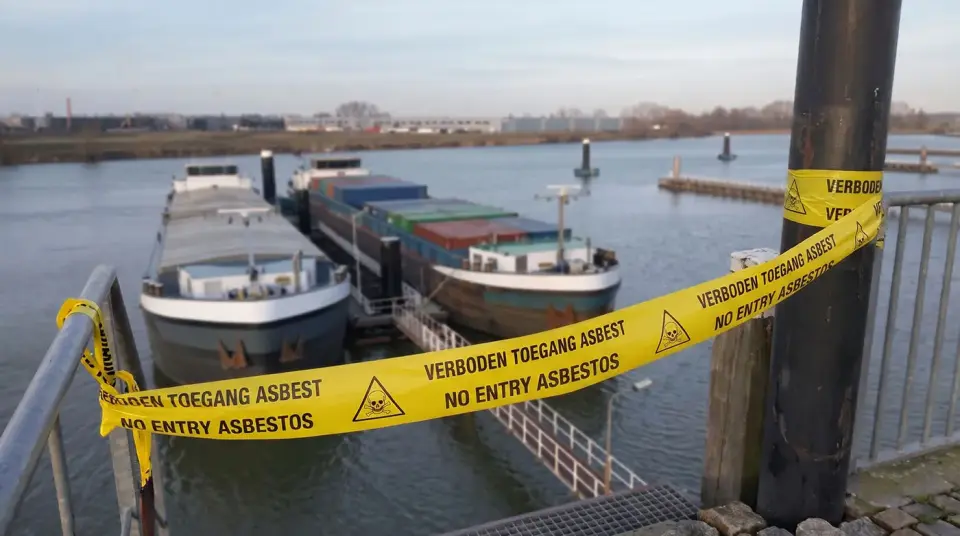
The Human Environment and Transport Inspectorate (ILT) will check whether owners of inland waterway vessels have an asbestos inventory report, as previous inspections showed that such a report is not always available.
Inspections in inland navigation have shown that an asbestos inventory report is not always available. For this reason, the Human Environment and Transport Inspectorate (ILT) will check whether owners of inland waterway vessels have an asbestos inventory report.
This memo describes the background, the requirements and the way in which the ILT carries out its supervision.
Ban and health risks
Asbestos has been banned in the Netherlands since 1994. At European level, the ban has applied since 2005. Asbestos was widely used in installations, vessels and trains because it is heat-resistant, fire-resistant, wear-resistant and strong.
Asbestos is classified as a carcinogenic substance. In the long term, exposure can lead to lung cancer, mesothelioma, cancer of the larynx and ovarian cancer. Exposure can also cause the following conditions:
- Asbestosis: chronic scarring makes the lungs stiff, so that breathing becomes increasingly difficult.
- Pleural plaques: the pleura thickens due to benign calcification.
When does asbestos pose a risk?
Asbestos-containing materials do not pose an immediate hazard as long as they are in good condition and are not worked on or removed. Fibres are released when materials or parts of machinery and installations are damaged, for example through demolition, ageing, processing, maintenance, fire or an incident.
The fibres are microscopically small and not visible to the naked eye. When inhaled, they penetrate deep into the lungs. Exposure does not cause immediate symptoms: there are often 10 to 40 years between inhalation and the onset of disease. The risk depends on the amount of fibres a person has inhaled over their lifetime. The greatest risk lies in prolonged or occupational exposure, but short-term exposure is not without risk either.
Where is asbestos found?
On vessels built before 1994, asbestos-containing material may be present in various places. In practice, this includes:
- gaskets and seals on flanges, covers, hatches and installations, such as (electric) engines, pumps and piping;
- insulation material on boilers, exhausts, piping and in the engine room;
- brake shoes on winches, engines and other mechanical applications;
- vinyl floor covering, sealants and adhesives in engine rooms and accommodation;
- (partition) walls, ceilings and (fire-resistant) panels.
A vessel built in 1994 or later is not automatically asbestos-free. On vessels built outside the Netherlands, asbestos may be present in many locations. In other EU countries the ban did not apply until 2005, and outside the European Union asbestos is still mined and used. Where the asbestos is located is difficult to determine, because different regulations apply in other countries. Asbestos can also be brought on board after construction, for example through maintenance, repairs, conversion and the purchase of technical parts outside the European Union.
Sometimes asbestos only comes to light during work at the shipyard. This can lead to additional investigation, delays and higher costs. Early insight into the presence of asbestos helps to plan maintenance better and to share information appropriately with third parties.
Asbestos inventory
Vessel owners are obliged to have an asbestos inventory report drawn up and to make it available to the parties carrying out work on the vessel (Articles 3 and 5 of the Asbestverwijderingsbesluit 2005 and Article 4.54a of the Arbeidsomstandighedenbesluit). The inventory provides insight into the presence and location of asbestos-containing materials on board. It forms the basis for the safe preparation and execution of maintenance, repair and demolition work. This protects crew members, maintenance technicians, shipyard personnel and other persons involved.
A report in which no asbestos has been found only provides certainty about the parts that were examined within the scope of the inventory.
The ILT carries out targeted inspections of vessel owners with vessels flying the Dutch flag. The asbestos inventory obligations also apply to vessels flying another flag.
If a vessel is maintained or repaired at a shipyard in the Netherlands, the following must be assessed before work starts:
- whether an asbestos inventory is required;
- whether the existing asbestos inventory report is up to date and sufficiently complete for the planned work.
A new asbestos inventory report is not required for every maintenance job. If the report is missing or incomplete, or provides insufficient insight into the materials being worked on, the inventory must first be carried out or supplemented. Work can only start after that. The relevant data must be available to the parties preparing and carrying out the work, so that appropriate protective measures can be taken.
ILT inspections
The ILT may visit vessel owners for a targeted asbestos inspection. This consists of three parts:
- an interview with the vessel owner’s contact person;
- a walk-through on board;
- a check of the documents and the maintenance records.
If asbestos is (possibly) present, the ILT pays attention to the following points, among others:
- No asbestos fibres can be released. The vessel owner knows the asbestos rules and takes measures so that people and the environment do not come into contact with fibres.
- A certified asbestos inventory company has carried out an asbestos inventory before the maintenance or conversion started.
- The maintenance records state whether asbestos has been worked on previously and whether an asbestos inventory was carried out at that time.
- Work during which large amounts of asbestos fibres can be released has been carried out by a certified asbestos removal company.
- During maintenance, the rules of the Asbestverwijderingsbesluit 2005 are followed.
- Other work waits until the asbestos has been removed.
- There are no spare parts containing asbestos in the store.
Consequences of a violation
In the event of a violation, the ILT can issue a warning or impose an order subject to a penalty. The vessel owner then pays a sum of money for as long as the violation has not been remedied. In the case of serious violations, the ILT can draw up an official report for the Public Prosecution Service.
Regulations and other supervisory authorities
The asbestos rules are laid down in the Asbestverwijderingsbesluit 2005 and in the REACH Regulation (EC) No 1907/2006. The Netherlands Labour Authority (NLA) may also visit vessels. The NLA supervises working conditions and checks whether employers provide a safe and healthy working environment.
Advice
We advise vessel owners to check the following points:
- Is an asbestos inventory report available and is it up to date?
- Do the maintenance records state what has previously been done with asbestos?
- Are the spare parts free of asbestos and can this be demonstrated?
Support from Transafe
During our on-board visits, we assess the maintenance records and working methods relating to asbestos against the requirements and discuss the points of attention.
Drawing up an asbestos inventory report is outside the scope of our services, because this requires a certified asbestos inventory company. We do provide guidance throughout the process and, on request, put vessel owners in touch with such a company.
If you have any questions about this subject, please feel free to contact us.
Source: Toezicht op asbest in industriële installaties, schepen en treinen | Inspectie Leefomgeving en Transport (ILT) (in Dutch)