MEMO - Notification of incidents
29 october 2026
All equipment in hazardous areas on board must demonstrably be safe. This applies to both electrical and mechanical equipment. The ADN requires two separate lists of equipment.
The notification obligation applies only when dangerous goods are involved and a packaging is involved, such as a drum, IBC, tank-container, tank-vehicle, wagon or tank ship.
Always first assess whether Article 47 WVGS applies, regardless of the quantity released.
1. Direct notification obligation (Article 47 WVGS)
Who must notify?
The party carrying out the operation during which the occurrence arises. If the occurrence takes place during loading or unloading, the terminal is regarded as the filler or unloader within the meaning of ADN/ADR/RID, even if the incident actually occurs on board the vessel. If several parties are involved, one notification is sufficient, provided this is agreed between them and the notification is made without delay.
When to notify?
Any occurrence in which danger to public safety** arises or may arise must be notified without delay*
*Meaning of 'without delay':
Contact is made immediately after the situation arises and once the first immediate safety measures have been taken.
**Danger to public safety:
‘Public safety’ is a broad concept. It covers not only the safety of those directly involved in the transport, such as employees, but also the safety of the surroundings and everything located there. Promoting public safety means preventing danger, damage or nuisance to people, animals and the environment caused by dangerous substances (Explanatory Memorandum to the WVGS, unofficial translation)
Relevant operations for terminals:
- Loading and unloading (ADN/ADR/RID)
- Filling and emptying of packaging
- Connecting and disconnecting loading and unloading arms [ONZEKER] and hoses
- Parking or stationing means of transport carrying dangerous goods
- Other directly related operations
Notify the ILT by telephone (urgent) via 088 489 00 00 (24/7) in case of:
- Release of dangerous goods from packagings or articles
- Damage to people, animals or the environment
- Obstruction of the infrastructure
- Incidents in which emergency services are actively deployed.
- Incidents on public roads or waterways in which the means of transport no longer complies with the statutory requirements, and where waiting until the next working day is not an option.
Call immediately. In the case of a late notification, the ILT asks for the reason for the delay. Failure to notify, or late notification, may result in a fine or even an order subject to a penalty payment imposed by the ILT.
Notify digitally via www.ilent.nl (non-urgent) in case of:
- Drip leaks at valves, manhole covers, overflow pipes or packagings, within an enclosed site
- Damage to (tank) containers on site, such as corner fittings or frame.
- Leaks during pressure tests or when connecting and disconnecting hoses, without immediate danger to the surroundings.
After the notification
Stop further operations until the ILT has assessed the occurrence and released the means of transport, the tank or the packaging. Only operations reasonably necessary to prevent further danger or damage are permitted, such as closing valves, collecting product, deploying oil booms or extinguishing a fire. The means of transport, the tank or the packaging may not leave the site until the ILT has granted release.
Also inform the safety adviser (Transafe): 078 68 24 300 / info@transafe.info
2. Reporting obligation (ADN/ADR/RID 1.8.5)
After the notification, must a report under ADN/ADR/RID also be drawn up?
No, not always. Only in the event of a serious accident or incident.
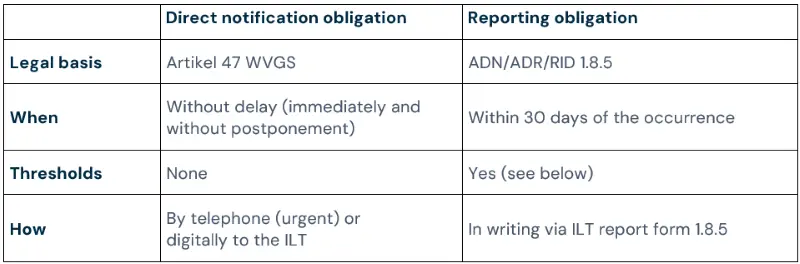
The reporting obligation is a separate obligation and does not replace the direct notification obligation.
A written report to the ILT (within 30 days, via report form 1.8.5) is required for serious occurrences that meet one or more of the criteria below.
Note: these thresholds apply exclusively to the reporting obligation under 1.8.5. They do not apply to the direct notification obligation under Article 47 WVGS.
An incident involving personal injury:
An occurrence in which death or injury directly relating to the dangerous goods carried has occurred, and where the injury:
a) requires intensive medical treatment,
b) requires a stay in hospital of at least one day, or
c) results in the inability to work for at least three consecutive days.
(Risk of) Loss of product: the release of dangerous goods in the following quantities:
|
ADR/RID column (15) |
ADN |
Threshold |
|
|
a |
Transport category 0 or 1 |
Packing group I |
50 kg or 50 litres or more |
|
b |
Transport category 2 |
Packing group II |
333 kg or 333 litres or more |
|
c |
Transport category 3 or 4 |
Packing group III |
1.000 kg or 1.000 litres or more |
The criterion of product loss also applies if there is a risk of loss of product. This is the case when the means of containment are damaged to such an extent that safe transport of the product is not further possible.
Property or environmental damage
The release of dangerous goods, irrespective of the quantity, where the estimated amount of damage exceeds € 50.000. Damage to any directly involved means of transport containing dangerous goods and to the modal infrastructure is not taken into account for this purpose.
Involvement of authorities Authorities or emergency services
In case that they are directly involved during the occurrence, and persons are evacuated or public traffic routes (roads, railways, inland waterways) are closed for at least three hours as a result of the danger caused by the dangerous goods.
In practice, the information required for the 1.8.5 report is usually already available from the incident documentation prepared for the WVGS notification. The report can be completed in consultation with the safety adviser.
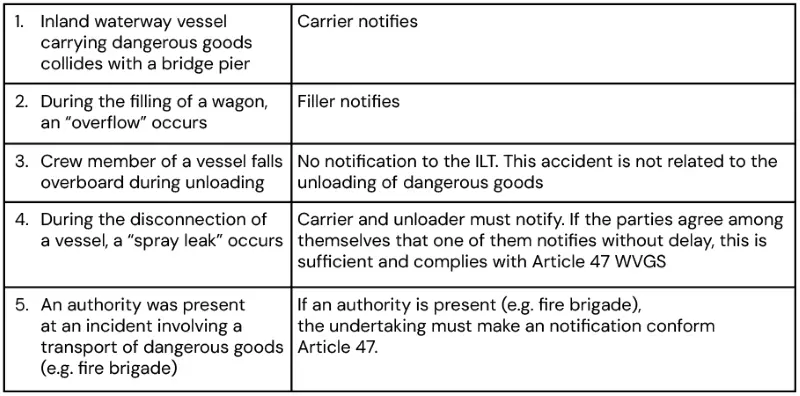
Notification of incidents involving dangerous goods must be included in procedures, and failure to notify incidents can have adverse consequences. Annex I contains a number of examples of who must notify.
For any questions on this subject, please contact Transafe via the button below.
Contact
Annex I: Examples of who must notify