

MEMO: Mechanical equipment in hazardous areas
3 September 2026
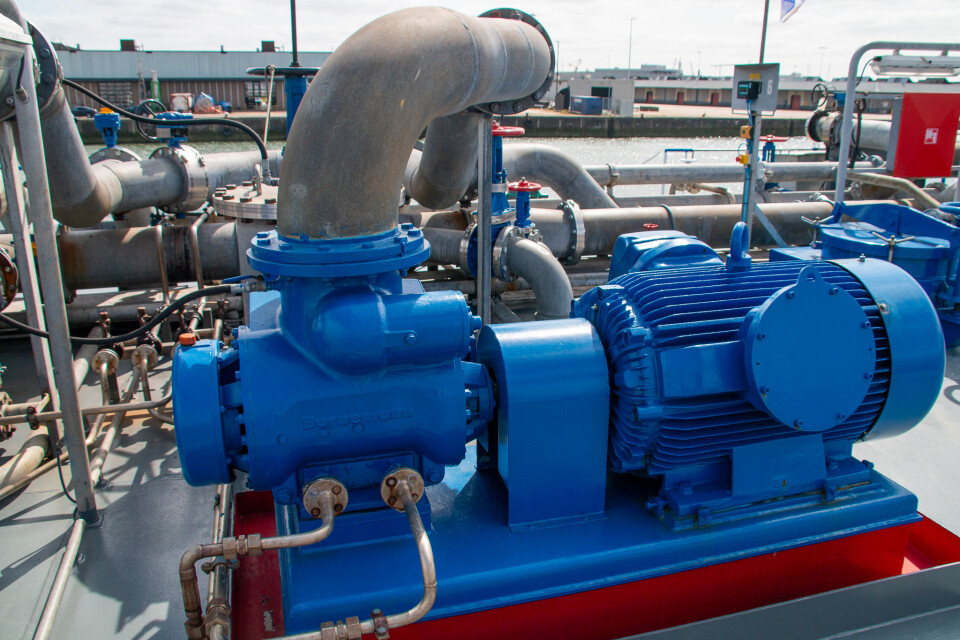
All equipment in hazardous areas on board must demonstrably be safe. This applies to both electrical and mechanical equipment. The ADN requires two separate lists of equipment.
The ADN sets requirements for all equipment located in hazardous areas on board. This applies not only to electrical installations, but also to mechanical equipment such as pumps, agitators and fans. This equipment must comply with the ATEX requirements applicable to the zone in which it is installed. In addition, it must be included in the prescribed equipment lists. This memo explains what this means in practice.
What does the ADN require?
The ADN distinguishes between the requirements for electrical and non-electrical installations and equipment used or installed in hazardous areas.
Tank vessels (ADN 9.3.x.53)
On vessels with a zone classification: all electrical and non-electrical (mechanical) installations and equipment in a hazardous area must be suitable for that zone. The type of equipment required depends on the substances permitted to be carried.
Dry cargo vessels (ADN 9.1.0.53)
On dry cargo vessels: electrical equipment in the protected zone must be capable of being switched off. This is not required if the equipment is already suitable for zone 1, temperature class T4 and explosion group IIB, or if the equipment on deck is "restricted explosion-safe".
Equipment without electrical drive that is used during loading and unloading must also be suitable for that zone, at minimum for temperature class T4 and explosion group IIB.
Documents required on board
In accordance with ADN 8.1.2.2(e) to (h) and ADN 8.1.2.3(r) to (u), the following documents must be kept on board:
Equipment list:
- a list of all permanently installed equipment in zone 1;
- a list of permanently installed equipment that must not be used during loading, unloading and gas-freeing;
- a list of permanently installed equipment that may be used during loading, unloading and gas-freeing.
Zone plan:
- a drawing showing the boundaries of the hazardous areas, including the electrical and non-electrical equipment installed therein;
- a list of the equipment shown on the zone plan, stating the location on board, explosion group, temperature class, type of protection and testing authority;
- the autonomous protection system, with location on board and marking (applicable to tank vessels only).
How are the hazardous areas classified?
The zone classification applies to tank vessels whose list of permitted cargoes includes substances for which explosion protection is required.
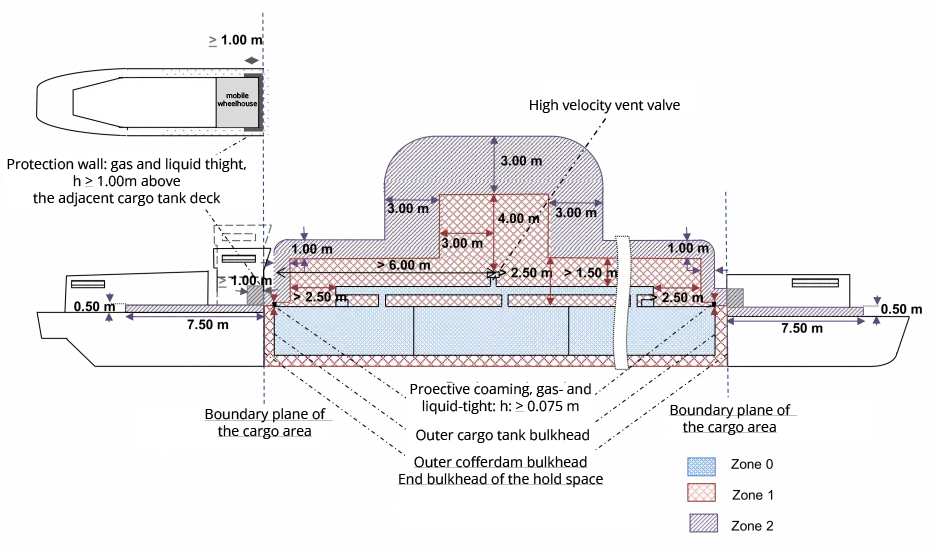
- Zone 0: inside cargo tanks, residual cargo tanks, pipes containing cargo or cargo vapours, and cargo pumps.
- Zone 1: all spaces below deck in the cargo area that do not fall within zone 0, enclosed spaces on deck in the cargo area, and a strip around the cargo tanks and their openings.
- Zone 2: a smaller strip adjoining zone 1, and areas around ventilation openings and safety valves, and on the fore and aft decks adjoining the "boundary plane of the cargo area" over the full breadth of the vessel for a length of 7.50 m.
On dry cargo vessels, a different classification applies under the name "protected zone":
- Zone 1: the cargo hold.
- Zone 2: the area on deck around the cargo hold.
The electrical equipment list
The electrical equipment list includes all electrical installations and equipment located in a hazardous area on board.
For each item of equipment in zone 0 or zone 1, the following data must be recorded:
- the type of installation or equipment;
- the location on board;
- the complete ATEX marking.
The electrical equipment list demonstrates that all electrical equipment in the hazardous areas is suitable for the zone in which it is installed. The shipowner, classification society and competent authority can use this list to verify that the electrical explosion protection on board is in order.
The mechanical equipment list
Mechanical equipment does not run on electricity, but can still constitute an ignition source in hazardous areas. Examples include pumps, winches and fans.
The mechanical equipment list includes all non-electrical installations and equipment in zone 0, zone 1 and zone 2.
- For zone 0, the following must be stated: location on board, equipment protection level (EPL) marking, including explosion group and temperature class, type of protection, and testing authority.
- For zone 1 and zone 2, it is sufficient to state the identification number of the equipment. A copy of the certificate of conformity may be enclosed as an alternative.
Equipment must be included on the mechanical equipment list as soon as it is capable, by design and operation, of constituting a realistic ignition source during normal operation or under reasonably foreseeable conditions of malfunction. There is no fixed temperature threshold that in itself determines whether equipment belongs on the list.
The assessment is carried out through an ignition hazard assessment. Possible ignition sources assessed include:
- hot surfaces resulting from friction or wear;
- sparks from friction, for example from worn bearings;
- static electricity, for example from liquid flow through a pump;
- sparks from impact in the event of defects or malfunctions;
- mechanical failure under reasonably foreseeable conditions of malfunction.
For zone 0 and zone 1, rare malfunctions of the equipment must also be taken into account. This makes the assessment more complex than for zone 2.
A particular consideration for rotating equipment such as pumps, agitators and fans is the peripheral speed (expressed in m/s). The higher this speed, the greater the risk of temperature rise due to friction. Peripheral speed therefore directly influences the temperature class assigned to the equipment.
Distinction between the equipment lists
and the role of the temperature class
The temperature class (T1 to T6) indicates the maximum permissible surface temperature of equipment in order to prevent ignition of the gases or vapours present:
Class |
Max. surface temperature |
| T1 | 450 °C |
| T2 | 300 °C |
| T3 | 200 °C |
| T4 | 135 °C |
| T5 | 100 °C |
| T6 | 85 °C |
For electrical equipment, the temperature class is shown on the nameplate and is entered directly on the equipment list. For mechanical equipment, the temperature class is one of several assessment criteria. The determining factor is the complete analysis of all possible ignition sources.
Transitional provisions
The requirement applies to vessels for which new construction, replacement or conversion (N.R.C.) has taken place after 1 January 2019. This applies to both tank vessels and dry cargo vessels.
For vessels already in service before 1 January 2019, transitional provisions apply:
- Dry cargo vessels (ADN 9.1.0.53): upon renewal of the Certificate of Approval after 31 December 2034.
- Tank vessels (ADN 9.3.x.53 and ADN 8.1.2.3(t)): upon renewal of the Certificate of Approval after 31 December 2034.
As long as the zone classification is not yet required under the transitional provisions, at least a drawing must be kept on board showing the boundaries of the cargo area, including the electrical equipment installed therein.
Summary and advice
Verify whether the vessel has the correct and complete equipment lists. In practice, mechanical equipment is regularly overlooked, even though the obligation is already in force.
For questions about electrical or mechanical equipment on board, or about compliance with the equipment list requirements, please contact us via the button below.
Contact