

MEMO: Communication between shore and vessel secured?
9 June 2026
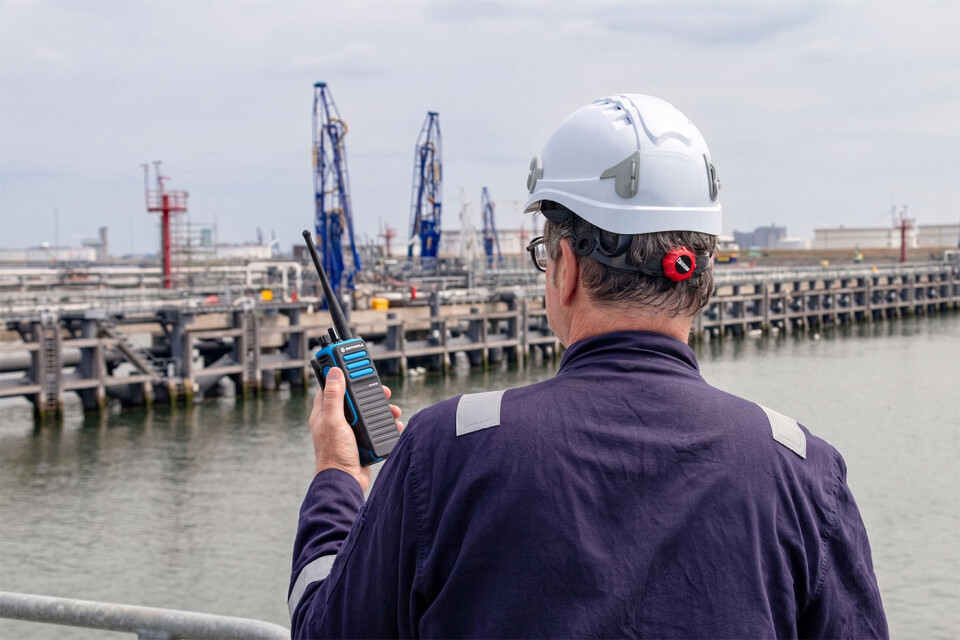
The ILT has identified at multiple terminals that communication between shore and vessel during transfer operations is not always sufficiently secured. Read what the ADN requires.
Background
Following inspections at various terminals, the Human Environment and Transport Inspectorate (ILT) has established that communication between the terminal (acting as loader or unloader) and the vessel crew during transfer operations is not always sufficiently secured.
Reliable, guaranteed communication is important to ensure that vessel crews can be informed and instructed at all times, both during normal operations and in emergencies. The requirement to ensure continuous adequate communication is therefore included as an obligation in the ADN.
What the ADN requires
Question 11 and the explanatory notes to question 11 of the ADN checklist (ADN 8.6.3) stipulate, among other things, that communication between vessel and shore during transfer operations must be properly arranged and secured.

The accompanying explanatory note states:
Question 11
For a safe loading/unloading operation good communications between vessel and shore are required. For this purpose telephone and radio equipment may be used only if of an explosion protected type and located within reach of the supervisor.
Potential risks during transfer operations
(also noted during ILT inspections)
During transfer operations, situations may arise in which communication is no longer adequately secured, for example when:
- the radio does not function properly;
the radio is not within reach of the deck watch;
the person responsible for communication has been replaced and the new person does not have sufficient command of the required language;
the relevant person has become unwell.
It is therefore important that communication is not only checked prior to the start of transfer operations, but that it is demonstrably secured throughout the entire transfer.
ILT interpretation
The ADN does not explicitly prescribe how communication must be secured. The ILT indicates that contacting the person responsible for supervision and communication on deck at least every 15 minutes is in any case considered a suitable measure for securing communication.
It should be noted that this 15-minute frequency does not constitute a hard requirement, but is an example of an approach that can demonstrably provide sufficient communication security.
The responsibility to demonstrate that communication has been effectively secured throughout the entire transfer operation remains with the terminal. The ILT has indicated that a monitoring frequency of, for example, once every two hours or once every four hours (as in ISGOTT) is in its view insufficient.
Securing communication in practice
Throughout the transfer operation, multiple contact moments take place that are not primarily intended to check communication, but in practice contribute to it. During transfer activities, communication moments often occur that are not always recognised as a communication check, but effectively function as one.
Examples include:
- calls to switch from initial flow rate to mid-rate;
- operational coordination between shore and vessel;
- safety and terminal rounds along the jetties;
- verification of the radio during physical checks on board.
These contact moments also contribute to verifying communication between shore and vessel and can therefore form part of the overall communication security. In doing so, the risks mentioned above can be identified and addressed in a timely manner.
When these contact moments are plotted on a timeline, it may become apparent that sufficient monitoring moments are already in place. In that case, it may be sufficient to make use of existing moments, supplemented where necessary by one or more targeted contact moments during the transfer to demonstrably secure communication, rather than applying a fixed check every 15 minutes.
In addition, supplementary technical solutions can be considered, such as a periodic signal or connection check via the radio or a man-down function. In combination with operational and physical checks, this can also contribute to sufficiently secured communication.
Conclusion
It is important that communication between shore and vessel is demonstrably secured throughout the entire transfer operation, in accordance with the requirements of the ADN.
The way in which this security is implemented can be risk-based and operationally appropriate, provided the terminal can demonstrate that communication is effectively, continuously and verifiably secured. A fixed 15-minute check is not the only possible solution, but it is an example of a measure that the ILT considers sufficient.
In practice, this can be demonstrated through a combination of operational contact moments, physical checks and, where necessary, supplementary technical verifications.
The terminal remains responsible for demonstrating that the chosen approach maintains an equivalent level of communication security throughout the entire transfer period.
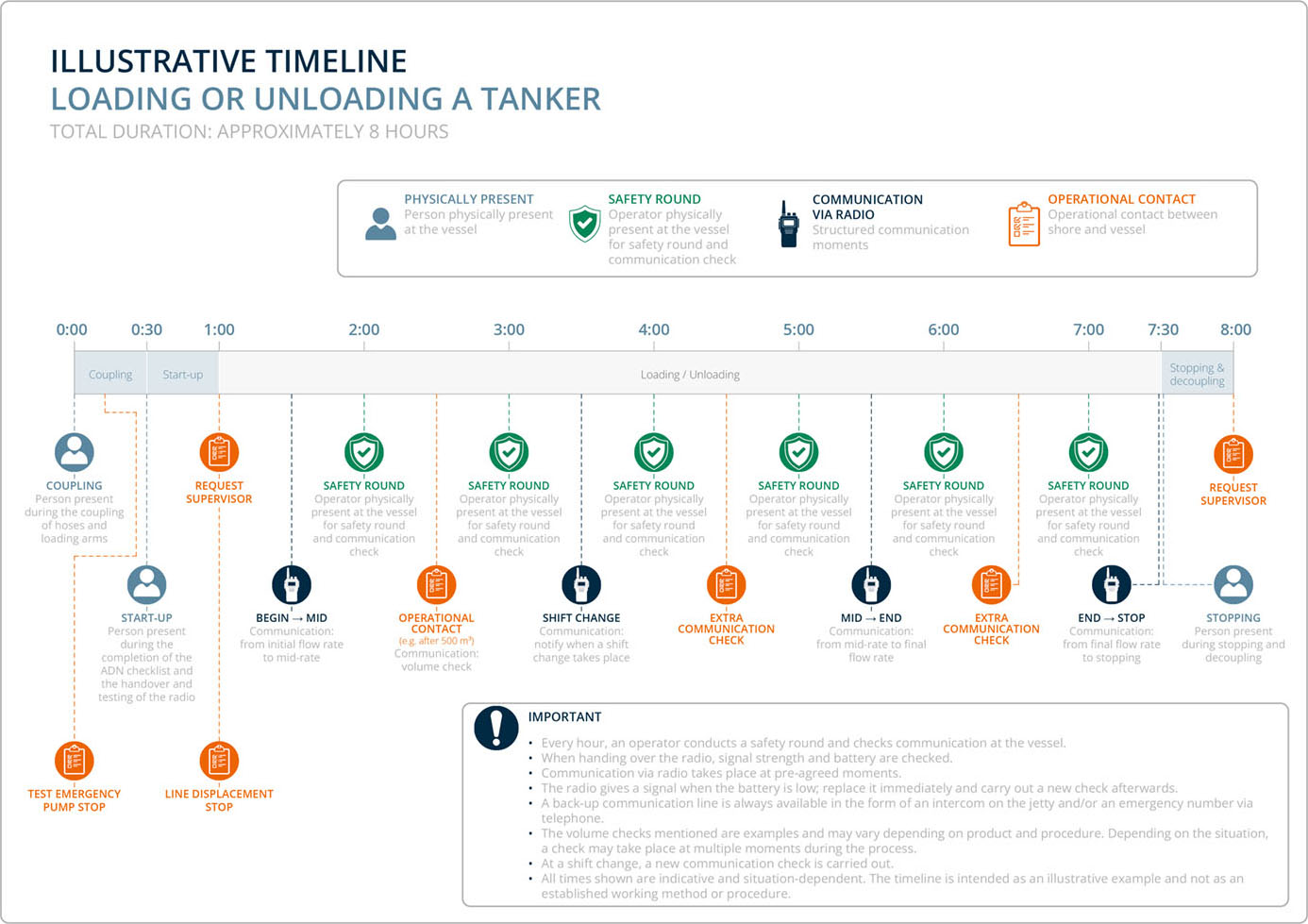
Disclaimer: the timeline included is for illustrative purposes only. Each terminal or transfer location has different operational processes, and timelines may therefore vary. Should you require a timeline tailored to your specific operational situation, we are happy to prepare one.
For questions on this subject, please contact us using the button below.